Personal contributions made to design considerations for a hypothetical augmented reality system, and the economic side of managing a hypothetical RC plane construction project. Autumn 2010, autumn 2011.
Christopher Clayton
02/20/2012
9 December 2010, Foreword 20 February 2012
Foreword to design considerations for an augmented reality system
This is part of a greater team document regarding the hypothetical design of an augmented reality game system user interface for indoor and outdoor use. This section is the requirements part which I explicitly wrote. I also collaborated on the entire twenty-page document, along with planning user surveys and field tests, but I didn’t participate in conducting mock field tests myself. I also collaborated on creating a 60-page MS PowerPoint presentation with clickable branching paths for navigating the interface’s menu, including during a sample game session.
The name for the hypothetical system ("Reach") is credited to Julius Magsino.
Body text regarding the design scope and business scope for an augmented reality video game system
Users undertaking activities with the Reach system must have some basic abilities in order to play any of the games. We evaluated our own idea of a zombie game, Man vs. Zombies, and a ping pong game adapted to an augmented reality system and interface. Specific requirements and limitations, as well as general concepts applicable to games in general, are discussed. This covers the function of the design, as well as non-functional requirements that we wanted to emphasize, such as usability and how much users had fun.
In terms of physical requirements, a user must have visual and auditory functionality, as well as being able to move about physically. One need not use actual sports equipment for those kinds of games, but this would also heighten the user experience in those cases, or any other appropriate props for other games. Therefore the physical requirements are mainly aerobic and motor skill-based. The user must know that the full three-dimensional range of visual and auditory sense is used, because there is no 2D interface limit. This is also reflected in the lack of radar or other game mechanics used in various 2D game interfaces to compensate for lack of 3D sense.
Requirements after these basic assumptions can be learned, or one may use prior knowledge, such as knowledge of how to play sports. For example, in the ping pong game, one may learn how to play ping pong from an in-built tutorial, learn by some other means, or play by prior knowledge. We chose to have tutorial modes for games in order to preclude needing documentation. For tutorial modes, in order to cut down on text, an audio instruction system would be used, but otherwise visual symbols depending on the game’s needs could further the place of text. The system can thus handle some kinds of user limitations as well. We wanted to keep the user from being bombarded with more information than they could handle at one time, and from missing key information.
As a unit meant for outdoor exercise, the design stage required consideration for easy portability (light weight, slim). That led to a choice of glasses, bracelets and anklets for all functionality. The unit as a whole should be highly robust in order to stand up to any kind of reasonably intense aerobic work and movement (i.e. combinations of martial arts moves).
Based on survey data, we designed the system to have hardware which is not customizable. Therefore the hardware is in-built and requires intermediate technical skills in order to replace parts, if users can get access to compatible parts at all. However, because it is a console device, it should have a long life with low maintenance requirements, so long as users do not damage the main unit (glasses) and peripherals by making sure the equipment is secure. It falls within an affordable price for a fully-featured console with up-to-date capabilities, but because of the advanced technology, such as fitting a CPU and graphics unit into a pair of glasses, the device is futuristic. The graphical and computation capabilities should also be high with few limitations given futuristic use.
These requirements reflect our choice of target demographic of college students. We assume they have certain skills and capabilities, and also tend to have some technical familiarity with how to use digital devices.
Our device is meant to help with losing weight or to become better with existing athletic skills. The device has few prerequisites, but also appeals to a wide audience as well. Our persona, Stephanie, reflects this. She can get around her busy work and school life using the device quickly and efficiently in different environments in order to make time for exercise, such as playing an indoor sport. In the main she is in shape and has a history of exercise, but could not find the time in her new life to do so.
The menu interface presents challenges to the way beings interact with the physical world, but in the future, people may also be more familiar with virtual object manipulation within augmented reality. However, the issue remains that a floating interface projected virtually would have no touch but respond to movement on virtual buttons, so a user would have to familiarize with those conditions. Modern-day touch-screen users could more easily learn it, but there would only be visual feedback in this case and possibly audio. In our design, the menu options branch out when touched, and they have labels and pictures that make them as intuitive as possible to understand. A user can also go back to any branch and the rest disappears. Users should easily learn how to set up their own profiles, check scores and begin games. They also must know that if they want to add any peripherals, they must go to the corresponding menu item and confirm nearby devices that they want to use into main unit memory. Those devices cannot be put into another main unit memory unless they are deleted from the original unit. The menu and games are seamlessly integrated because they both use the surrounding environment. Therefore, a user needs to know both how to navigate through the menu to start a game, but also know that virtual entities (AI, objects) will be spawned after setting session options and beginning the game.
For any games involving roaming AI entities, we chose to have them spawn within a particular boundary. Users can see where the boundary is, but they must know that going past it triggers the game to pause. Any AI or session events freeze, and the pause menu appears, which can be used to terminate the session, etc. It is also necessary to give such games a limit for social purposes and to define a game environment, and also represents software limits if a maximum range is included. However, this technology is futuristic and may be capable of a range that we would not want to include in regards to the other aforementioned boundary considerations. Users must also know that they will phase through AI entities, but the entities will respond realistically to attacks or getting pushed around if there is enough force, so in that case they would not be phased through. However, certain movements will definitely result in more obvious phase-through events, such as walking through an enemy without enough force to knock down, and users must understand this and get used to it. In order to deal with the user’s unrestrained physical abilities further, in the zombie game we used a gameplay mechanism of a symbol appearing in front of a zombie when it is about to attack. The user must either dodge or attack in a certain way, also indicated by symbols, in order to deal with the threat, or take virtual damage. If the user loses all health or takes enough hits, it is game over. If all enemies are defeated, the player has beaten the session. However, other gameplay modes such as survival with infinite enemies with the same limit on health are also possible.
The use of AI in the zombie game example was also made simpler than the device could potentially calculate in the interest of promoting exercise over more complex gameplay. A user only has to know how to attack specific enemies or dodge them, who come up to the player in a simple pattern and attack after a certain time period. However, in order to be fair we would also need a system of AI entities giving chase and causing virtual damage to a user running away too quickly and extensively, because the user has no physical limitations. We did not test this, because people were used in place of AI, but it is a feature to consider to prevent users from exploiting such games. This also applies to manually pausing the game or stepping out of bounds to pause, because to prevent exploitation, any AI entities should be moved relative to where the player once was if the player moves in pause mode.
In a game of ping pong, a virtual table requires getting used to as well. The system software could be programmed to not spawn a table of certain dimensions within an area that could not handle it, but the user must be aware of this and choose GPS coordinates that are compatible. If one is playing multiplayer at a distance, i.e. the opposing player is treated as virtual due to their far-away location, both users must coordinate to have the same equivalent real-world space in order to play against one another.
Multiplayer in any game on such a system also poses other user requirements. They must know that any two users with main units within range can play games such that they see the same virtual entities, and can work together to accomplish tasks. It is assumed that fast internet connectivity allows the users to link up quickly and begin playing games. A radio feature also allows them to communicate if they are farther away from one another. Other concerns such as pausing the game and AI entities being moved relative to player movement while in pause mode apply in order to prevent exploitation of the virtual world because of lack of physical limitations. This also means that if one person pauses the virtual world, the same pause screen would appear for the other person automatically.
Users must understand that the glasses are the main hardware unit. All primary interaction with virtual entities and the menu takes place with it, and its GPS scans the world within the given boundaries in order for the graphics processor to create hit detection which any AI entities follow, project the AI and other virtual entities, etc. Secondly, they must understand that the bracelets and anklets are used for further hit detection and where the user’s body parts are relatively oriented to one another. This was our primary usage for such peripherals when designing a zombie game, but for other games a belt could be added for further relative body part and virtual object spacing, such as for a virtual inventory of weapons, and the bracelets could detect item locations and movements within a player’s hands. However, we did not include items such as weapons or bandages in the zombie game because it would detract from the goal of providing exercise.
Beyond any games that initially come with the unit, the Reach store allows users to download more games online. The main memory is stored in a flash drive in the glasses, and we assume that it has a reasonable amount of space. If a user has to delete games to obtain more space, they can download them at a later point if they wish for free because their purchase status will be stored on their account. Any data that users might want to keep, such as scoring, is stored on their account, or backed up if a copy is stored on the internal drive. Any account information whatsoever is held in the utmost privacy under a secure server and connection, and is not shared with third parties.
Peripheral-based and/or main unit body scanners are assumed to produce calorie readings based on accurate and in-depth bio-metric readings, which software routines process and store. The calorie results for sessions could be used as part of a raw score which could be compared to others using menu options, and are meant to be simple. However, such data would be most useful for users who have exercise goals and know what it means for them to lose a certain number of calories within a play session, or a certain amount of time doing particular exercises.
After we tested the product once, users found it to not be as simple to use or as fun as it could be. We made different adjustments, such as text-cutting, in order to appeal to this, and users in the second test found the device much more likable and simple. Users also completed tasks more quickly. We could further improve the device, but as it stands, it has the key features we wanted. The Reach 2.0 represents further changes on a hardware level.
Items originally written October-December 2011, Foreword 20 February 2012
Foreword to principles and root cause analysis for a hypothetical RC plane construction project
These samples are the share of what I contributed for a project management class, with the topic being how to plan and manage a Design Build Fly project. A real contest in Wichita exists for building such designs, but this was solely in regards to a hypothetical RC plane project subject to those flight objectives and construction guidelines. Besides what I contributed, I also helped add items concerning technical aeronautics and industrial engineering (e.g. ergonomics) topics, along with other assorted topics and collaborated on diagram creation. However those sections are too thoroughly mixed with different people contributing, so I am not including them, only paragraphs which I remember entirely writing myself.
Overall the project spanned two twenty-page papers analyzing aspects such as the work breakdown structure in terms of the roles of the design and production team and the logistics of construction and deployment. Finally we created smaller paper concerning risk analysis using the fault tree method.
Refined Cost regarding construction of an RC plane
The basic cost of the project comes from gathering materials. Balsa wood makes up the body, along with Kevlar. Fasteners, wiring, fuses and cords add further to basic material needs. Exact cost depends on quality of materials and the amount or quantity of certain materials used.
The engine is commercially purchased, so no money can be saved through team fabrication. Cost might vary in regards to engine specifications such as horsepower, and brush versus brushless motors. Connection to the propeller may be through direct drive, or through extra systems such as gear or belt reduction, providing a choice with corresponding impacts on spending. A mechanical motor arming system adds further device costs but acts as the required failsafe system.
Pilots also receive remotes, and a corresponding radio transmitter and servos are installed on the plane. In the case of the latter, an extra battery pack separate from the engine pack is required, which thus also means more batteries. In regards to the propeller the same commercial requirement holds, but the blades may be painted and the tip clipped, adding slight additional costs in the case of the former.
Staff costs do not exist at all because of the use of a student team who must design as well as fabricate the aircraft. However, if certified construction workers and electricians could be used, it would guarantee build quality of the aircraft. Staff costs would arise in this form, but it would also open the option of having insurance.
Space rental for construction exists, unless the university provides a free area to work. Other small costs exist as well such as the use of office supplies for design and the printing of documents, which might include advertising to find crew members.
Refined Benefit of undertaking an RC plane project
Students benefit in the main by gaining direct design and some construction/fabrication experience by working on the project. This allows them the opportunity to apply lessons learned in the classroom. Students get to work both in a team and independently pursue other tasks for the project, teaching them organizational skills.
The backdrop of a competition with a fixed deadline also teaches them to work in a competitive environment and complete tasks in a timely manner. In this regard, students also gain satisfaction if their design wins the competition. They further get to participate in a new environment through traveling to another part of the US, that is, if they do not live in or are not from Wichita.
More expensive material use can aid the quality of the final product. The same also applies if professional, certified staff could be used for construction of the body and installation of all electrical systems. Possible use of insurance by proving certified construction would also prevent a major accident from completely destroying project assets, even though costs would increase for such risk protection.
Technical Scope regarding RC planes (the half that I wrote)
Preparation before the construction of the aircraft will be made by creating multiple versions of the product, constructing a prototype from which the final construction of the aircraft will be made. The aircraft design must account for functionality beyond competition mission requirements to ensure durability and performance. However, it shall not include wholly unnecessary extra systems such as advanced radar functionality. Increasingly high-spec power plants also eventually become too expensive relative to use, and the same for increasingly high airframe specifications such as with material strength.
3.8 Affordability
The project must keep within funds available provided by sponsors. This means decisions about what kinds of materials to use, etc. must be considered on a cost basis. Aspects must receive more or less funding based on importance, versus needless spending, such as adding greater quality for unnoticeable improvement.
4.0 Test and Evaluation
Table 2: Test and evaluation matrix
Legend: D = Design, A = Assembly, I = Inspection, DT = Design Test, QT = Qualification Test, AT = Assembly Test
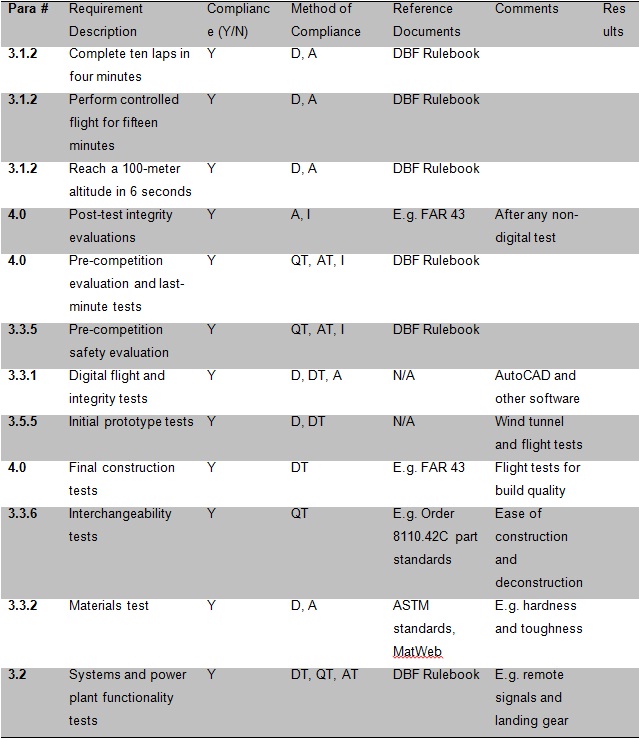
(Table formatted by Ben Dorsy)
Risk Analysis Paper Sample
6. Countermeasure Recommendations
This section proposes countermeasures to the root cause that can result in the general problem situation. A number of solutions to the root cause are proposed, as well as solutions to problems that arise.
To increase speed for achieving lift-off in another attempt after the event of failure, the engine can be inspected and fixed if it is not meeting specifications. If it is an issue with inherent engine incapability, the final solution must include purchasing and installing a new engine, or other aspects of the plane modified or overhauled to accommodate that engine.
If the wings do not provide acceptable lift in spite of the plane meeting lift-off speed requirements for that particular airframe design and weight, they must also be inspected and tweaked as necessary. The final solution must include a complete re-design of the wings in the event of the discovery of a fundamental design fault, or the airframe design and the engine must be tweaked or overhauled in other ways to accommodate that wing design.
The RC control system cannot act as a problem in this situation. In such a case, the plane would not start at all, which is beyond the scope of this situation. It can include issues which can be ruled out with easy fixes, such as replacing defective batteries and changing frequencies in the event of a signal conflict.
Weather conditions do not serve as a problem in this situation as well because the runway conditions can be inspected. In this way issues with lift-off due to poor weather can be prevented, either by canceling the test for that time or improving runway conditions to an acceptable level.